Bitcoin Supply Squeeze ETFs Are Absorbing More BTC Than Miners Produce

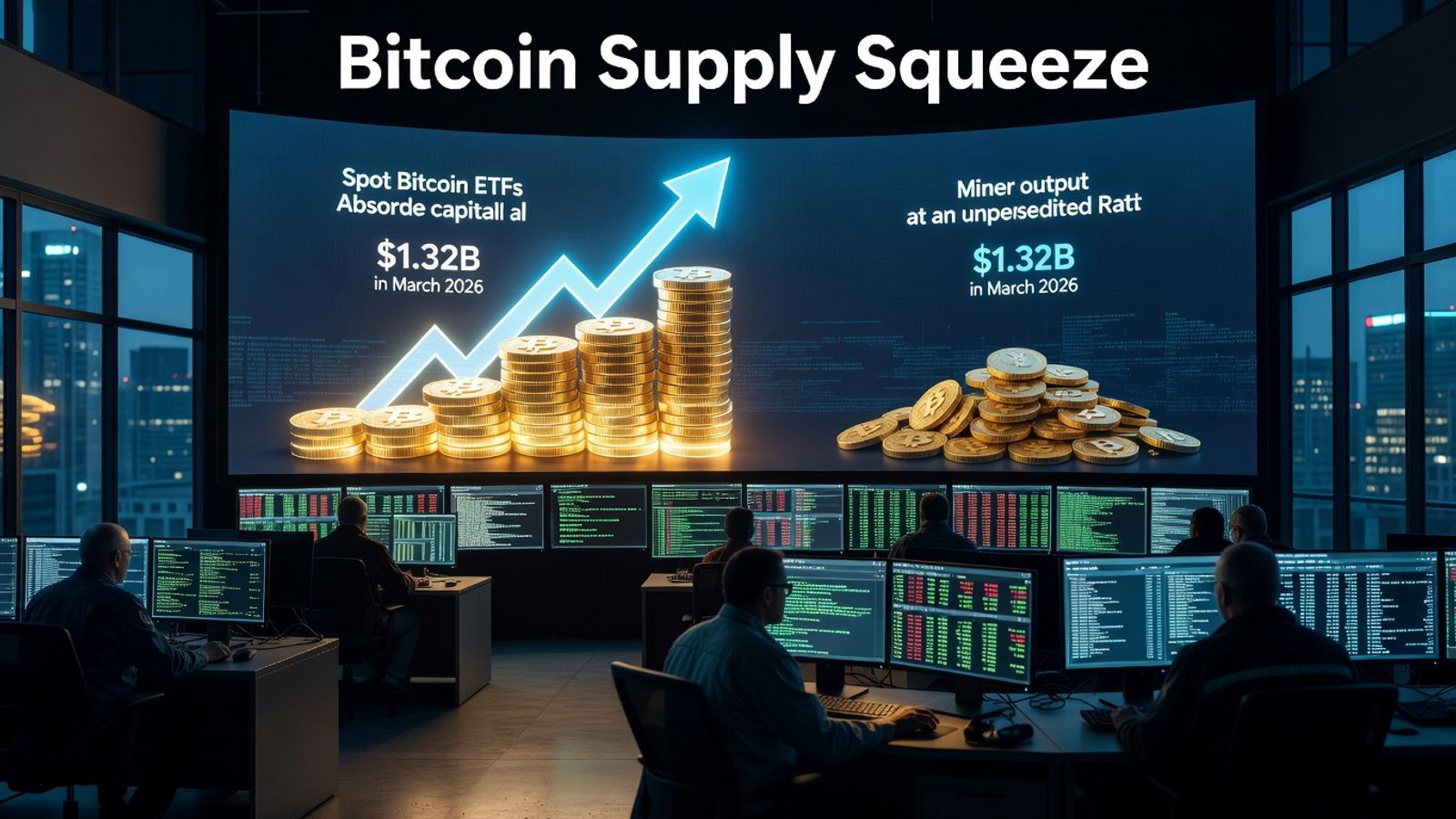
Spot Bitcoin ETFs took in $1.32B in March 2026, their first positive month since October. Meanwhile, miners are selling to fund AI pivots. The supply math is getting interesting.
Bitcoin is trading around $74,400 this week after bouncing from $70,500 lows. The Fear and Greed Index sits at 21, still deep in "extreme fear" territory. But behind the fearful sentiment, something structural is shifting.
On April 6 alone, spot Bitcoin ETFs absorbed roughly $471 million in net inflows. At prevailing prices, that works out to approximately 6,700 BTC in a single day. Bitcoin miners produce about 450 BTC per day. Do the division: ETFs absorbed 15 times the daily mining output in one session.
This is not a one-day anomaly. March 2026 was the first month of net positive ETF flows since October 2025, with $1.32 billion coming in. Spot Bitcoin ETFs now hold 1.298 million BTC, representing 6.18 percent of total supply, worth approximately $96.5 billion.
The supply side is contracting at the same time. Bitcoin miners are selling billions of dollars in reserves to fund a pivot toward AI data center operations. The hash rate remains high, but the BTC that comes off the machines increasingly goes straight to institutional buyers rather than onto exchanges.
This is the supply squeeze narrative in real time.
What the flow data actually shows
The April flow pattern tells a more nuanced story than the monthly total. After the $471 million inflow on April 6, we saw -$159 million on April 7, then +$358 million on April 9, +$257 million on April 10, -$291 million on April 13, and -$326 million on April 14. Flows are volatile day to day, but the net direction over the past month has been positive.
Analysts like TheCryptoKazi on X have called the current Fear and Greed levels the "greatest buying opportunity in crypto," while others such as 0xnorsed point out that extended periods of extreme fear have historically preceded major moves. The on-chain data supports the argument: exchange reserves continue to decline while ETF custody balances grow.
The question is not whether demand exists. The question is whether the current price adequately reflects a market where institutional vehicles are absorbing supply faster than the network can produce it.
What changes the equation
Two things could accelerate this dynamic in Q2 2026.
First, the Digital Asset Market Clarity Act (H.R. 3633) is moving through Congress. The bill would place Bitcoin firmly under CFTC jurisdiction as a digital commodity, removing the regulatory uncertainty that has kept several institutional players on the sidelines. Wintermute estimates a 30 percent chance of passage this year. Even the prospect of passage has been enough to get TradFi desks positioning ahead of time.
Second, the post-halving supply reduction is biting harder than most expected. The April 2024 halving cut the block reward to 3.125 BTC, and the math is unforgiving. Fewer new coins plus rising institutional demand equals tighter markets. Miners selling into the rally is the main release valve keeping prices from running away. Once that selling dries up, the next leg up does not need much catalyst.
The fear is real, but the structure underneath it is not
Extreme fear readings tend to cluster near bottoms, not tops. That does not mean the bottom is already in. Geopolitical tensions and Fed hawkishness could push prices lower before they push them higher. But the supply and demand mechanics are shifting in a way that favors patient capital over reactive traders.
ETFs are not going to stop buying. Miners cannot produce more coins than the protocol allows. And the clarity bill, if it passes, removes the last regulatory excuse for institutions to sit out.
The supply squeeze does not need to happen all at once. It just needs to happen.